Best AI Detectors (2026): Originality.ai, Pangram, Grammarly and QuillBot Compared
This page has no affiliate links right now: every link goes straight to the vendor. If that changes, we'll say so here. How we make money.
An AI detector is a tool that estimates whether a piece of text was written by an AI model such as ChatGPT or Claude. The best AI detector depends on how much you check: free tools are fine for a single essay, while publishers need bulk scans and reports. None of them is proof on its own.
The short answer
For a free spot check, use Grammarly or QuillBot. For checking many articles with plagiarism in the same scan, Originality.ai Pro costs $12.95/mo billed yearly. Pangram ($20/mo) also checks images and video. Always treat a score as a clue, not proof.
How AI detectors work, and why they can be wrong
AI detectors look for statistical patterns. AI models tend to pick predictable words and even sentence rhythms, and a detector is trained to spot that. It gives you a score, not a fact: “this text looks 80% like AI writing”.
That guess can be wrong both ways. Human writing can be flagged as AI, which is called a false positive. AI text that a person has edited can slip through. A 2023 Stanford study, “GPT detectors are biased against non-native English writers”, found that several widely used detectors often misclassified essays by non-native English writers as AI-generated.
Vendors say this too. Grammarly’s detector page says “No AI detector is 100% accurate” and that you should never rely on a detector alone. QuillBot says detection gets harder as AI models improve. So never use a detector score as the only evidence against a student, a writer or an employee.
Quick picks: best AI detectors compared
| Tool | Best for | Price | Free option | Plagiarism check |
|---|---|---|---|---|
 Originality.ai | Publishers and SEO teams checking many articles | Pro $12.95/mo billed yearly ($155.40/yr) or $14.95/mo billed monthly | Small free allowance (see limits) | Yes, in the same scan |
 Pangram | Individuals who check text, images and video | Individual $20/mo; Professional $65/mo | 7-day free trial on Individual; no free plan on the pricing page | Similarity detection on every scan |
 Grammarly | A quick free check with no account | Free | Free; the page says no sign-up is needed | Separate plagiarism checker |
 QuillBot | Free checks of English text | Free | Free for Free and Premium users; text box labelled 1,200 words | Separate plagiarism checker |
Prices in USD and free limits as shown on each vendor’s page on November 24, 2026. Grammarly and QuillBot sell writing plans, but their AI detectors are free.
How we chose
We included AI detectors that have full profiles on this site, plus the free detectors from Grammarly and QuillBot, two writing tools many people already use. We re-read every price, credit rule and free limit on November 24, 2026 from the vendors’ own pages, using a US server. We compared price, free access, plagiarism checks and extra formats such as images. We haven’t tested these tools hands-on, so we don’t rank them by accuracy, and any accuracy figure on this page is the vendor’s own claim.
Other well-known detectors include GPTZero, Copyleaks and Turnitin. We don’t have verified profiles for them yet, so we don’t list their prices here.
Originality.ai: best for publishers and SEO teams checking many articles
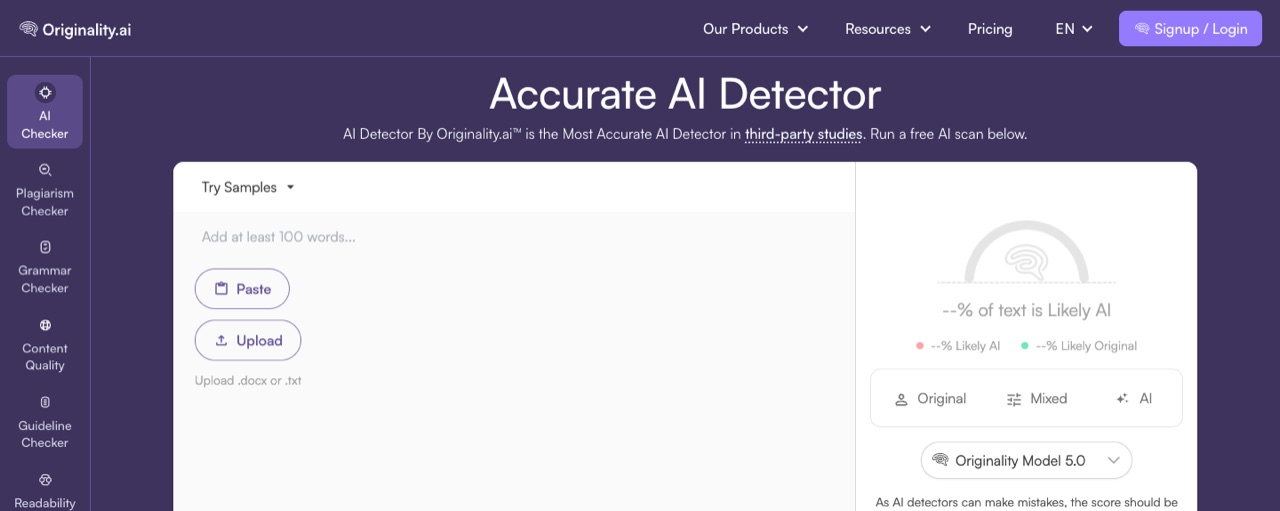
AI-content detector and plagiarism checker for publishers, agencies and editors, with fact, readability and grammar checks, browser extensions, an API and an MCP connector.
What you get:
- Pro: 2,000 credits a month. 1 credit = 100 words, so that is 200,000 words of AI-only checks a month
- An AI check costs 1 credit per 100 words; an AI plus plagiarism check costs 2 credits per 100 words
- Pro adds bulk scans, file upload (docx, pdf, doc), shareable reports, PDF downloads, team management and 30 days of scan history
- Enterprise ($136.58/mo billed yearly, $1,638.96/yr, or $179/mo billed monthly) has 15,000 credits a month, API access and 1 year of scan history
- The page also lists fact-checking, readability and grammar tools
Limits: Subscription credits expire at the end of each month, so unused credits don’t roll over. The free plan is described two ways on the same page: “100 credits one time” on the plan card and 60 credits renewing daily in the comparison table, so check your account before you rely on either.
What the vendor claims: Originality.ai calls itself “The Most Accurate AI Detector” for ChatGPT, GPT-4o, Gemini Pro, Claude 3.5, Llama 3.1 and other tools. That is the vendor’s claim; the pricing page shows no test method or error rates.
Who it's for: Editors, agencies and site owners who buy or publish a lot of written content and want AI and plagiarism checks in one report.
Skip it if: You check a few essays a month. A free detector may be enough, and Originality’s paid credits reset every month.
Visit Originality.aiRead the Originality.ai profile
Source: originality.ai/pricing, checked November 24, 2026
Pangram: best for individuals who check text, images and video
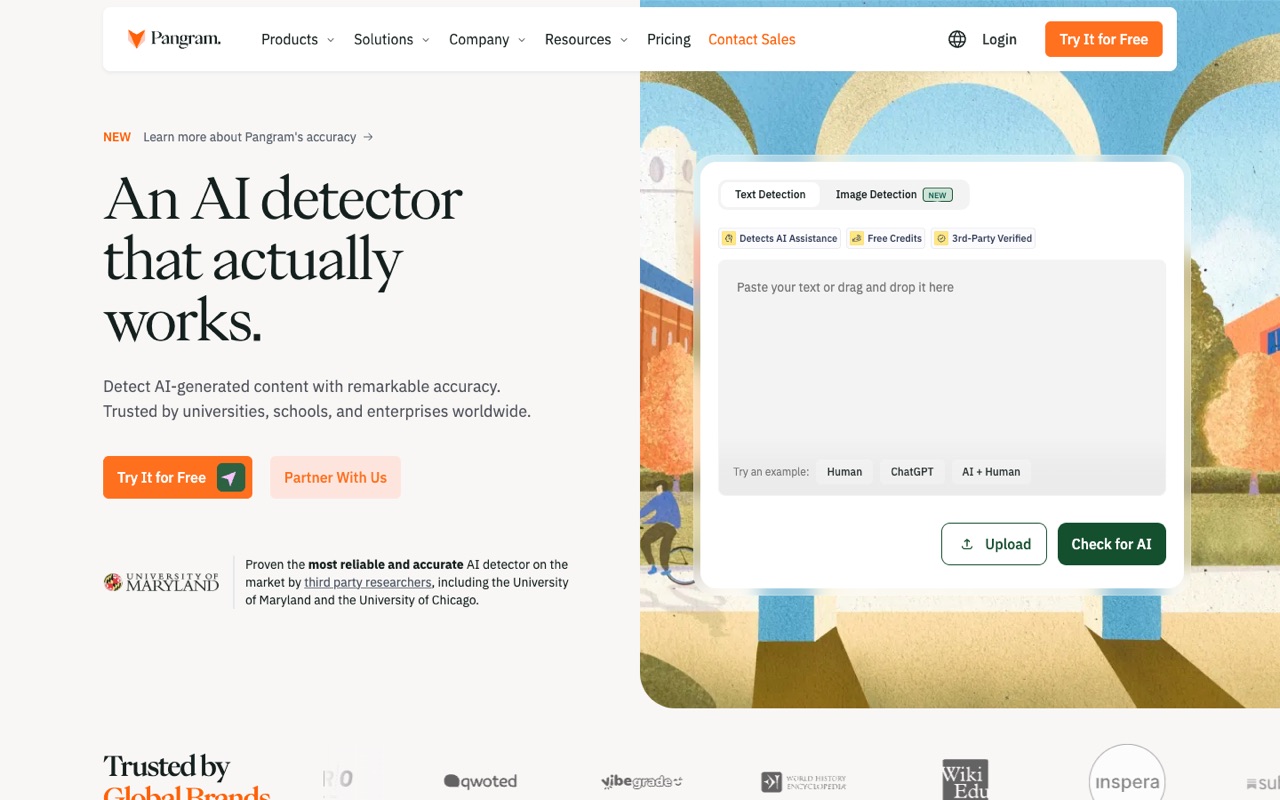
AI-text detector from Pangram Labs that flags fully AI-written and AI-edited passages, with image detection, a plagiarism check, a Chrome extension and an API.
What you get:
- Individual: up to 300,000 words, 600 images or 50 minutes of video a month
- $10 of API credits a month on paid Individual plans (not during the trial)
- File upload with OCR for scanned documents, plus Google Docs and Gmail integrations
- A feature that auto-scans your social media and Substack feeds, and access to Pangram’s MCP connector
- Professional ($65/mo): 5x more scans and $200 of API credits a month
Limits: The page says yearly billing saves $60 a year on Individual and $240 on Professional, but it doesn’t print the yearly price. On the API, text costs $0.05 per 100 words. Team and school plans are under “Organizational” and go through sales.
What the vendor claims: Pangram’s page describes its detector as “Remarkably Accurate” with “Third-party verified results”. It doesn’t print an accuracy percentage or a false-positive rate on the pricing page.
Who it's for: Writers, editors and teachers who want one subscription that also checks AI images and video, or who want detection inside Google Docs and Gmail.
Skip it if: You only need an occasional text check. Grammarly and QuillBot both offer free detectors.
Visit PangramRead the Pangram profile
Source: pangram.com/pricing, checked November 24, 2026
Grammarly: best for a quick free check with no account
Writing assistant that checks grammar, clarity and tone, with generative AI features for rewriting.
What you get:
- A percentage score for how much of your text “appears to be AI-generated”
- A breakdown that marks passages as “Resembles AI text” or “No AI text patterns found”
- Grammarly says it identifies text from ChatGPT, Gemini, Claude, Microsoft Copilot and its own AI
Limits: The page doesn’t state a word limit per check. Grammarly’s plagiarism checker is a separate tool, and its writing plans are priced separately (Pro was $12/mo billed yearly in our November 19 check).
What the vendor claims: Grammarly says its detector “Achieves 99% detection accuracy” and ranks first on the RAID benchmark. The same page also says “No AI detector is 100% accurate” and that you should never rely on a detector alone.
Who it's for: Students and writers who want to see how their own draft might score before they hand it in.
Skip it if: You need bulk scans, saved reports or a team workflow. The free detector checks one text at a time.
Visit GrammarlyRead the Grammarly profile
Source: grammarly.com/ai-detector, checked November 24, 2026
QuillBot: best for free checks of English text
Paraphrasing and summarizing tool with a grammar checker.
What you get:
- A score from 0% to 100% for how much of your text looks AI-generated
- Flags text for “further inspection” rather than giving a yes-or-no verdict
- Available to both free and Premium QuillBot users
Limits: QuillBot says the detector supports English only for now and checks text, not images or video. The paste box is labelled 1,200 words; the page doesn’t say whether that is a per-check limit.
What the vendor claims: QuillBot doesn’t publish an accuracy figure on the page. It says the better AI models get, the harder it becomes for any detector to tell human and AI text apart.
Who it's for: Students and bloggers who write in English and already use QuillBot’s paraphraser or grammar checker.
Skip it if: You write in another language, or need to check images or long documents in one go.
Visit QuillBotRead the QuillBot profile
Source: quillbot.com/ai-content-detector, checked November 24, 2026
Originality.ai credits explained: what 50 articles a month costs
Originality.ai charges in credits. One credit covers 100 words. An AI-only check uses 1 credit per 100 words, and an AI plus plagiarism check uses 2. Here is the math for a site that publishes 50 articles of 1,500 words a month:
| Check | Words a month | Credits used | Fits in Pro (2,000 credits)? |
|---|---|---|---|
| AI only | 75,000 | 750 | Yes, with 1,250 credits left |
| AI + plagiarism | 75,000 | 1,500 | Yes, with 500 credits left |
With AI plus plagiarism checks, Pro’s 2,000 credits cover about 66 articles of 1,500 words a month. At $12.95/mo billed yearly, 50 articles work out to about $0.26 per article (our math). Re-scanning an edited draft uses credits again, and unused subscription credits expire at the end of each month, so leave some room.
If you publish more than that, Enterprise has 15,000 credits a month. For comparison, Pangram Individual covers up to 300,000 words a month for $20/mo, which is 200 articles of 1,500 words.
How to use an AI detector fairly
This checklist works for teachers, editors and managers:
- Use it as a first look, not a verdict. A high score is a reason to ask questions, not a reason to punish.
- Check long enough text. Very short passages give the detector little to work with.
- Run a second tool. If two detectors disagree, that tells you the result is uncertain.
- Look at the process. Drafts, notes and version history in Google Docs or Word show how a piece was written.
- Talk to the writer. Ask them to explain their sources and choices. People who wrote the piece can usually do that easily.
- Be extra careful with non-native English writers. Research has found detectors flag their writing more often.
- Set the rules first. Say in advance whether AI help with ideas, grammar or editing is allowed.
FAQ
What is the most accurate AI detector?
Nobody can give a single honest answer, and we haven’t run our own tests. Vendors publish their own figures: Grammarly says its detector achieves 99% accuracy and ranks first on the RAID benchmark, and Originality.ai calls itself the most accurate detector. Treat these as vendor claims. Accuracy also changes with the text: short passages, edited AI drafts and newer AI models are harder for every detector.
Is there a free AI detector that works?
Yes, for spot checks. On November 24, 2026, Grammarly’s AI detector was free with no sign-up needed, and QuillBot’s was free for English text with a box labelled 1,200 words. Both give a percentage score. Originality.ai has a small free allowance, and Pangram offers a 7-day trial. Free tools don’t keep reports or scan in bulk.
Can AI detectors be wrong?
Yes. Detectors guess from patterns, so they can flag human writing as AI (a false positive) or miss AI text. A 2023 Stanford study found several popular detectors often misclassified essays by non-native English writers as AI-generated. Grammarly’s own page says no AI detector is 100% accurate and results shouldn’t be used alone.
Do teachers use AI detectors?
Some do, and vendors market to them: Pangram’s pricing page says it is trusted by professors. School policies differ a lot. A fair approach is to treat a high score as a reason to talk with the student and look at drafts and version history, not as proof.
Does Originality.ai detect ChatGPT and Claude?
Originality.ai says it does. Its pricing page lists ChatGPT, GPT-4o, Gemini Pro, Claude 3.5 and Llama 3.1 among the tools it detects. We haven’t verified this ourselves, and the page shows no error rates. Newer model versions may behave differently from the ones named.
How much does Originality.ai cost?
On November 24, 2026, Pro was $14.95/mo billed monthly or $12.95/mo billed yearly ($155.40 a year), with 2,000 credits a month. Enterprise was $179/mo billed monthly or $136.58/mo billed yearly, with 15,000 credits and API access. One credit covers 100 words; AI plus plagiarism uses 2 credits per 100 words. Prices are in USD.
Is Pangram free?
Not on its pricing page. On November 24, 2026, Pangram listed Individual at $20/mo with a 7-day free trial, and Professional at $65/mo. The page shows no free plan. Developers can sign up and pay per use on the API, at $0.05 per 100 words of text.
Can AI detectors check images?
Some can. Pangram’s Individual plan includes up to 600 image scans or 50 minutes of video a month. QuillBot says its detector checks text only. Grammarly’s AI detector page describes text checks.
Sources
All vendor pages checked November 24, 2026. Study: Liang et al., “GPT detectors are biased against non-native English writers”, arXiv 2304.02819 (2023), published in Patterns.
- originality.ai/pricing
- www.pangram.com/pricing
- www.grammarly.com/ai-detector
- quillbot.com/ai-content-detector
- arxiv.org/abs/2304.02819
Choosing a writing tool too? See the best AI writing tools, Grammarly vs QuillBot and Grammarly alternatives. See every tool in AI Writing.