
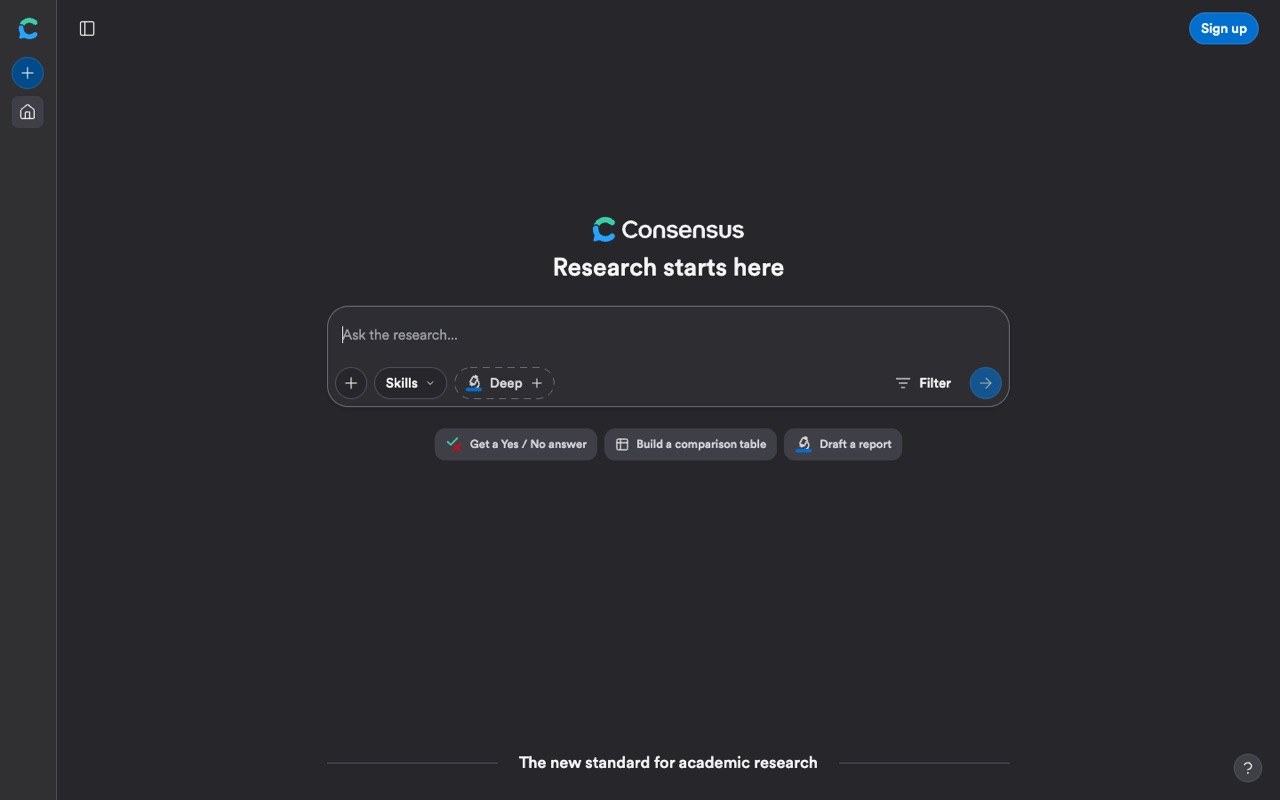
What does Consensus do?
Consensus is an AI search engine for academic research: it finds peer-reviewed papers first, then writes answers with citations you can check. Pro costs $12/mo billed annually, and a free plan exists. It suits students, clinicians and writers who need evidence; skip it if you want general web answers or a writing tool.
- Search-first answers. Consensus retrieves relevant papers before the AI writes anything, and says so when it cannot find enough evidence instead of filling gaps.
- Hybrid paper search. Combines semantic (AI embedding) search with keyword search, so you can use questions, keywords, Boolean operators, titles, authors or DOIs.
- Consensus Meter. For yes-or-no questions, shows how much of the research agrees or disagrees.
- Deep Review. Runs an in-depth synthesis of 50 to 100 papers for complex questions; plans include a monthly number of Deep reviews.
- Research Agent. Plans multi-step research, chains search and analysis tools and applies academic filters.
- Chat with full text. Ask questions across the full text of chosen papers, saved collections or your uploaded documents.
- Citation graph and library. Follow how papers cite each other and save papers into custom collections.
- API and MCP access. Paid plans include monthly API and MCP uses so you can call Consensus from other AI tools.
Who is Consensus for?
Consensus is a good fit if you're a blogger or a team lead, and you need help writing articles faster.
How much does Consensus cost?
Consensus starts at $12/mo. It also has a free plan. We checked this on Oct 29, 2026 on the official pricing page.
- Starts at
- $12/mo
- Free plan
- Yes
- Free trial
- Not offered on the pricing page
Pro billed annually ($144/yr; $20 billed monthly): unlimited Pro messages, 15 Deep reviews and 500 API & MCP uses a month. Deep is $45/mo annually ($65 monthly) with 200 Deep reviews. Teams $20/seat/mo annually ($30 monthly). Free plan: 10 Pro messages and up to 3 Deep reviews a month. Checked Oct 29, 2026.
Consensus plans compared
| Plan | Billed monthly | Billed yearly | What you get |
|---|---|---|---|
| Free | $0 | $0 | Basic paper search, 10 Pro messages and up to 3 Deep reviews a month |
| Pro | $20/mo | $12/mo ($144/yr) | Unlimited Pro messages, 15 Deep reviews a month, every research tool (search, analysis, citation graph), 500 API & MCP uses a month then $0.05 each up to 1,000 |
| Deep | $65/mo | $45/mo ($540/yr) | Everything in Pro, 200 Deep reviews a month, 2,000 API & MCP uses a month then $0.05 each up to 10,000 |
| Teams | $30/seat/mo | $20/seat/mo ($240/seat/yr) | Pro for up to 200 seats with 50 Deep reviews a month, account management, centralized billing and the Consensus Search API (500 API & MCP uses a month) |
| Enterprise | Not listed | Custom | Universities and larger organizations: volume discounts, library integration, SAML SSO (Okta, Azure AD, OpenAthens, Google Workspace), dedicated support |
Checked on Oct 29, 2026. The pricing table loads with JavaScript, so we read it in a browser and toggled monthly and annual billing; the figures match a US price tracker updated Oct 11, 2026. Annual billing saves $96 a year on Pro ($144 vs $240) and $240 on Deep ($540 vs $780). Students and faculty with a school email, and US clinicians with an NPI number, can get up to 40% off.
Checked Oct 29, 2026 on Consensus's pricing page. Prices change often, so confirm before you buy.
Consensus pros and cons
What stands out
- Answers come with citations you can trace to the source papers
- Free plan with a monthly allowance of Pro messages and Deep reviews
- Clear published prices for individuals and teams
- Retracted papers are flagged and excluded from AI analyses
- Up to 40% off for students, faculty and US clinicians
- API and MCP access included in paid plans
Watch out for
- Only covers academic literature, not the general web
- Deep reviews are capped per month on every plan
- Monthly billing costs about 67% more than annual on Pro
- AI summaries still need checking against the papers
- SSO only on custom-priced Enterprise
Based on Consensus's own pages, not hands-on testing.
What are the alternatives to Consensus?
We list 13 other AI Productivity & Meetings tools: ClickUp, ElevateForward, Evernote, MeetGeek, monday.com, Motion, Reclaim.ai, SaneBox, SmartSuite, Sunsama, Todoist, Wing Assistant, Wrike. Each one below shows its starting price and when you might pick it instead.

 ElevateForward · From $250/mo
Choose ElevateForward if you also need help planning my day and projects.

 MeetGeek · From $9.99/user/mo
Choose MeetGeek if you want a lower starting price ($9.99/user/mo vs $12/mo).
 monday.com · From $9/seat/mo
Choose monday.com if you want a lower starting price ($9/seat/mo vs $12/mo).








Consensus FAQ
How much does Consensus cost?
As of Oct 29, 2026: Pro is $12/mo billed annually ($144/yr) or $20 monthly; Deep is $45/mo annually ($540/yr) or $65 monthly; Teams is $20 per seat a month annually or $30 monthly. Enterprise is custom.
Is Consensus free?
There is a free plan with basic paper search, 10 Pro messages and up to 3 Deep reviews a month. Unlimited Pro messages need a paid plan.
What is the difference between Pro and Deep?
Both include unlimited Pro messages. Pro includes 15 Deep reviews and 500 API & MCP uses a month; Deep raises that to 200 Deep reviews and 2,000 API & MCP uses.
What is a Deep review?
A longer literature review in which Consensus synthesizes 50 to 100 papers on a complex question, per its help center.
Where does Consensus get its papers?
From Semantic Scholar, OpenAlex and its own crawl of the scholarly web, covering all fields of science and all of PubMed. The database is updated weekly.
Can I trust Consensus answers?
Answers cite the papers they draw on and retracted papers are excluded, but Consensus is an AI tool, so read the key studies before relying on a claim.
Is there a student discount?
Yes. Students and faculty with a valid school email, and US healthcare professionals with a valid NPI number, can get up to 40% off.
Does Consensus have team plans?
Teams covers up to 200 seats with central billing and account management; universities and larger organizations can ask for Enterprise with SSO and library integration.
Sources and how we checked
- Official pricing page, checked Oct 29, 2026
- Official website
- Consensus Help Center: How Consensus works (read Oct 29, 2026), checked Oct 29, 2026